
Skip to product information


DCTLSensor ArchiveNo. 03
Phone 2007 DCTL
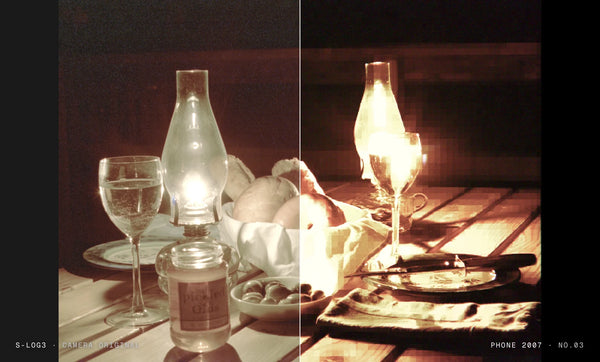
2000s phone camera colour plus the phone itself: low-res pixels, JPEG blocks, lens shading and chromatic aberration, in one Resolve node.
€29,99
Taxes included.
Buy 2 looks, save 15%. Buy 3 or more, save 25%. Applied automatically at checkout.
- Format
- .dctl
- Works with
- DaVinci Resolve Studio
- Delivery
- Instant download
Made by Thijs Kern, senior colorist. Graded for Nike, McDonald's, Mastercard and others.
Digital product, downloaded right after checkout. If something does not work, help is one message away.
Overview
2005-2008 phone camera colour: muddy shadows, a yellow-green cast, faded colour and an early clip.
Low battery, high memory.
The colour of a 2005-2008 mobile phone camera, rebuilt for modern footage, together with the phone itself. Muddy shadows, a yellow-green cast, faded colour, olive greens, washed-out skies and highlights that blow out early. The look of the first camera that was always in your pocket, made with the precision of a cinema grade.
What you will notice
- A steep, low-dynamic-range tone curve with muddy, crushed shadows.
- Highlights that clip early, under three stops above mid-grey.
- A yellow-green cast through the midtones and warm, yellowish highlights.
- Faded, uneven colour: greens slide to olive, blue skies wash out to a pale grey-blue, reds turn orange.
- Skin kept recognisable inside the cheap-sensor palette.
The phone, not just the colour
- Input Profile: built-in transforms for 15 inputs, from Sony S-Log3 and ARRI LogC to Apple Log, DaVinci Intermediate and Rec.709.
- Low Resolution: rebuilds the picture from a VGA or QVGA pixel grid, with optional hard square pixels.
- JPEG Compression: 8 × 8 blocks that flatten smooth areas, and colour that smears over each block.
- Sharpening: the crunchy in-camera sharpening of a tiny sensor.
- Sensor Noise: blotchy colour noise in the shadows, moving with your footage.
- Lens Shading: dark, magenta-tinted corners from a tiny lens.
- Chromatic Aberration: red and blue fringes towards the edges.
- 4:3 Frame: side bars for a 4:3 picture inside a 16:9 timeline.
- Look Strength, Exposure, Saturation, White Balance and Highlight Clip to tune the colour.
How to use it
- Select your input. Apply the DCTL to your log footage and choose its profile under Input Profile. In a colour-managed DaVinci Wide Gamut project, choose DaVinci Intermediate.
- Balance first. Set exposure and white balance before the DCTL.
- Apply Phone 2007, set the Look Strength, then add as much resolution loss and compression as the shot needs. The DCTL outputs Rec.709 Gamma 2.4.
How it was developed
Phone 2007 is built on how early camera phones made a picture: a tiny sensor with little dynamic range, a fixed-focus plastic lens, a cheap colour matrix and auto white balance that drifted towards green and yellow, all saved as a small, heavily compressed JPEG. The result is an original look that reproduces those characteristics on modern log footage, working on scene-linear light after a published-specification input transform for each camera.
Best suited for
- Music videos, fashion and social content with a low-res, 2000s feel.
- Night-out, party and backstage footage that should feel like it was shot on a flip phone.
- Memory and flashback scenes in short films.
- Indoor, mixed and low light, where early phones struggled most.
Requires DaVinci Resolve Studio. Sample images: OpenEXR test images, © Industrial Light & Magic.
Specifications
What you get, and where it works.
Included
Compatibility
Release notes
Version 1.0 — Initial release
Next step
Build your Resolve toolkit
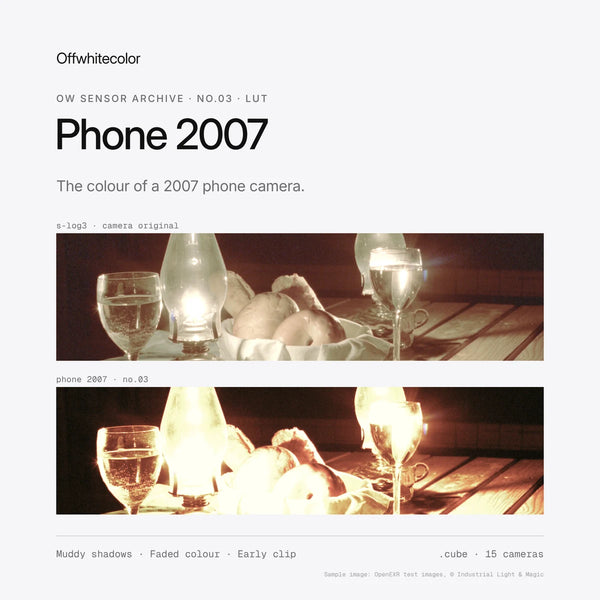
Pair the DCTL with the Phone 2007 LUT for Premiere, Final Cut and on-set monitoring. Buy 2, save 15% at checkout.
Or pair it with


Reviews
No reviews for this one yet. Across the store, 4.8 out of 5 from 21 verified reviews.
Every tool here is built the same way, by the same colorist. Read the reviews of Nostalgic Film
More from Offwhitecolor
Apple Log LUTs for iPhone


Brand, camera and film-stock names are trademarks of their owners, used only to describe what a tool models or accepts. Offwhitecolor is not affiliated with them.